
Old George

A memory, 1969
Old George lived at the end of our garden - well, in a small, one-storey house next door to the end of our garden. He was ninety-three, they said. A widower. He had fought in the Boer War.
His cottage had no electricity, no phone, and was not connected to the main sewer. In a small outhouse he had a chemical toilet - an Elsan - such as those we had endured at the more rudimentary campsites we were accustomed to visiting during the summer months. I imagined a thick soup of effluent, stinking in an old oil drum, with a rudimentary wooden seat balanced on top.
George frightened us. Not by anything he did or said but simply because of his age, his aloneness, his silence. It was as if he were a remnant of another time, caught in the jaws of our modern world by the torn sleeve of his aged jacket and the frayed peak of his cap.
He stood one day on a stepladder fixing a gutter - he was ninety-three, he was fixing his own gutter, from a step ladder. Back then no-one was ninety-three. To us children, it was an incomprehensible age. No-one could live that long. He was even older than Grandma. When we talked of him he was always ninety-three - never older, never younger. It was impossible that he had ever been younger. We could see he was trapped at that age, sculpted and fixed in time.
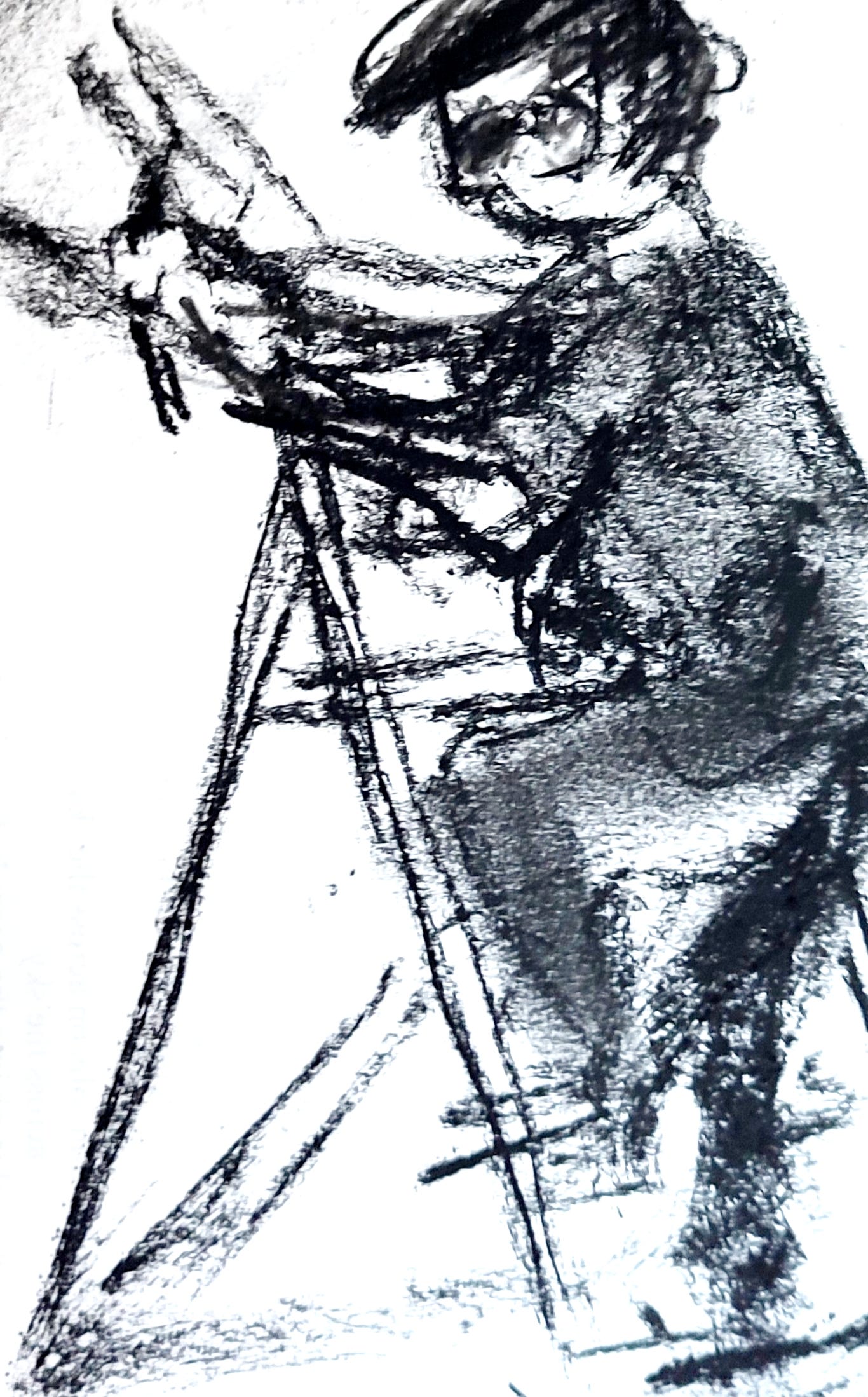
I hid among the branches of the leylandii to watch him as he worked. He wore his cloth cap, a ragged collarless shirt that had become partially untucked around his waist as he lifted his horny hands to the gutter support. While he worked he chewed. As I watched, he carefully leaned over his upraised arm and unexpectedly ejected from his mouth a jet of thick yellow liquid that splashed onto the ground. At first I thought it was vomit, but it had clearly been circulating in his mouth for some time, and it was projected from pursed lips not an opened throat. I felt the bile of disgust rise in my belly. I crept out of my hiding place and tried to cleanse the image from my mind. But the colour, clarity and speed of that streak of liquid ensured that it stayed with me. Even to this day.
At teatime, I told my father what I had seen, asked him if George was ill?
'No lad,' he said, 'it's just the tobacco he chews.'
‘He chews tobacco?’
‘Yes,’ said Dad, ‘like some people chew chewing gum.’
‘Eeww. Doesn't it taste horrible?’
‘I've never tried it, son, but I expect you get used to it.’
One morning, as my brother, my sister and I walked to the end of the road to the school bus stop, there was an ambulance outside George's cottage. The back doors of the ambulance were swung wide, but there was no-one inside. George's front door was open too, and I could see men in uniform talking in his cottage. We looked at each other with wondering eyes.
When the school bus dropped us off at four o'clock, the ambulance and the men had gone. When I got home I asked Mum what happened to George.
‘He had a fall,’ she said. ‘They've taken him to hospital in Plymouth.’
‘Really? They took him to hospital because he fell over?’
‘Yes. He didn't want to go but they took him anyway. He was very old. Ninety-six.’
‘Ninety-six? I thought he was ninety-three.’
‘Well he was. But now he's ninety-six. He didn't want to go because when he was a boy he grew up in Plymouth and the hospital there used to be a workhouse. He thought it still was. He didn't want to go to the workhouse.’
Later, I found out what a workhouse was. I felt sorry for him.
George never came home again. His house was empty for a long time. Tiles fell off the roof. The gutter sagged. The grass grew waist-high in his garden. If the ball ever went over the hedge, one of us would have to creep in and get it. It felt as if George was still there, that we shouldn't be trespassing. He might come out of his cottage at any moment.
But he never did.
A family of rabbits came and lived in his garden. They would slip through the bottom of the hedge that separated George's garden from ours.
They would eat Dad's carrots.